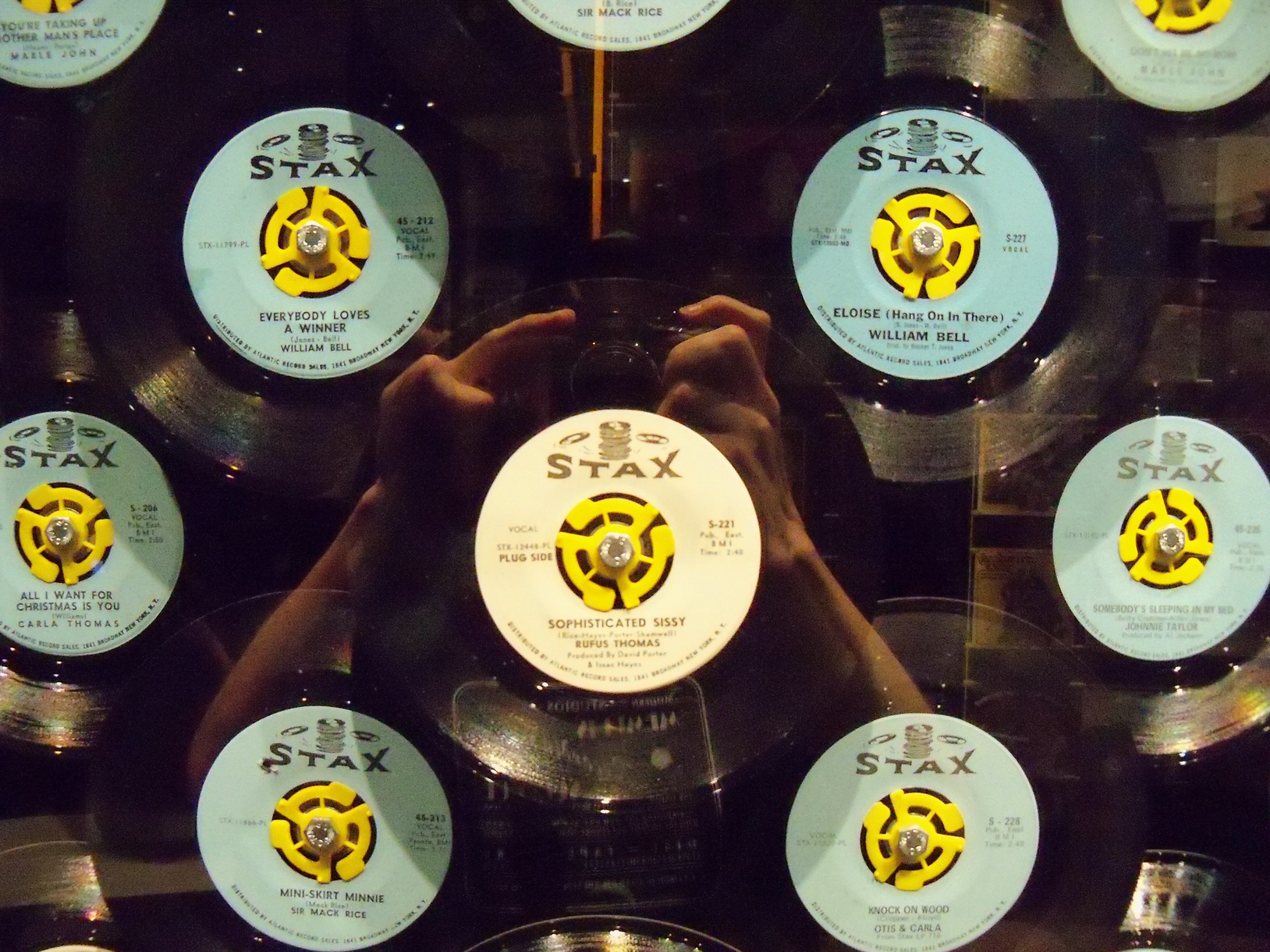
Blast from the past, thought I’d post a tale from my first collection of short stories, Bothering the Coffee Drinkers. The book came out in 2007 on the Canopic Press, earned a Independent Publisher Award nomination and became a nice counterpoint on music tours of the day as I’d break between sets to read something from the book. If I go back to the pages today, there is much I like, but much I would change, with the perspective of hindsight and growth. That said, “That’s How Strong My Love Is” is one of my favorite pieces in the book, evoking images of Memphis and Stax, in days gone by. It’s a time traveler tale, and a fairly long read, so buckle down and enjoy.
(“That’s How Strong My Love Is” – Doug Hoekstra)
Roosevelt hunched over a battered upright piano, voicing chords with long slender fingers and humming softly under his breath. A fan blew hot air around the small, tidy apartment, barely cooling the place. He was used to that, it was always hot in Memphis. What he wasn’t used to was finishing a song on this tight of a deadline. But, that’s what Steve had told him; come on down Saturday and play it for us, Otis is looking for material. It was Thursday and he was almost done, but there was a logjam on the chorus. Lord, he needed a break. He experimented with a couple of chords, moving around the root and seeing what that did or didn’t do to the chorus. Then he stopped and listened to nothing.
It was too quiet in the apartment, maybe that was it, he was so used to the sound of family, his wife and little boy moving about their four small rooms. They were visiting her mother in Jackson, and though he didn’t feel quite right without them, it did give him time to write. Lord, he needed a break; his schedule was killing him, working in the blood bank all day, dim lights and repetition, and then writing into the night, sometimes just in his head, after the baby was asleep. Managing the Echoes was okay, but he really wanted O.V. and James to go secular, it was time, they could broaden their world and he could leave the hospital behind. He spun around on the stool and stood up, grabbing his shirt from where he’d dropped it on the coffee table.
Some considered pride the greatest of sins, but not Roosevelt, at least when he came to a shirt he could really be proud of. It had a tall-boy collar, hand-sewn stripes, and was completely made of cotton, so it hung cool and loose. His wife bought it for him down at Lansky’s, and he thought of her as he put it on and walked into the bathroom to splash water on his face. He looked in the mirror. Man, he looked tired, there were dark circles forming on dark skin. Blood in my eyes for you, the old song goes. As he left the apartment, he stopped for a moment to glance at the empty bed and bassinet in the bedroom beyond the bath. Outside, he took a deep breath of night air and headed towards Beale, where he planned to take in some music and clear his head.
It was only a half-mile or so from where Roosevelt lived on Lauderdale to where he worked at Baptist Memorial, so he usually took the bus. But he drove on this particular Friday because he wanted to drop by a friend’s house in south Memphis after work and go over some booking possibilities for his acts. So, after the day came to a close, he hopped in his car, rolled down the window, and took 240 south. After he took care of business, he drove the long way back north, on South Bellevue Road, passing Forest Hill and Calvary Cemeteries, all shadows and graves sequestered behind a rolling chain-link fence. He crossed himself even though he was Baptist, and didn’t turn on the radio until he was well past their reach. He spun the dial a couple times with his index finger and heard nothing but the Beatles and the Rolling Stones, and some other English boys he’d never heard of. Roosevelt passed Elvis’ house and wondered what “the King” thought about all them young bucks stealing his thunder. He chuckled to himself and turned to WDIA for about a block and then, still restless, switched the radio off and found the melody of his new song working its way back into his head. That was a good sign. He started singing the first two lines to himself, thinking of his wife.
If I was the sun way up there,
I’d go with love most everywhere
It was a strong beginning, no doubt; the song was becoming part of the world, meaning it now existed in a place beyond his vision. A good song did that, just like a child, it grows up and goes off on its own, and hopefully, becomes stronger over time. Roosevelt saw his songs as something of God, not self, little pieces of beauty that shone through an often darkened world. But he still wanted to make money off them, and he wasn’t sure if this one was there yet. Maybe he had it, maybe he was just over thinking it, and maybe he was hungry and needed to work on a full stomach.
Roosevelt decided to pull into a Piggly Wiggly to get something to fix for dinner. As he circled the lot searching for an empty space, he ran across the strangest car he’d ever seen. It was a little snub-nosed thing, square as a box with a wide window in back, something like a cross between a golf cart and station wagon, and as he parked next to it, he noticed it was half the length of his Galaxy. He got out and walked around the car, surveying its small tires and complete lack of trim, and noticed two shadowy figures inside, one in the front seat, one in the back, each curled up in the fetal position. The window was fogged a little, so he knew they were breathing. No blood or shattered glass, either. How they could sleep all balled up in a car, in the Piggly Wiggly parking lot, he had no idea. They must be from out of town.
Roosevelt rapped on the window, driver’s side. The parking lot lights were dim but gave him enough to make out a curly black head of hair slowly rising from the front seat. The figure opened his eyes sleepily and then, spotting Roosevelt, jumped back with a start, hitting his head on the steering wheel, cursing. He was a little younger than Roosevelt, pale skin and rumpled clothes, blue jeans and a sleeveless t-shirt with a picture of some guy playing an electric guitar and raising his fist in front of an American flag on it. Someone in the back began to move, and Roosevelt saw he was another white fellow, with dark freckles and straight red hair parted in the middle, long enough to grace the top of his shoulders. Roosevelt had only known jazz cats to wear their hair that long. After he got a better look, he thought that one might be an Army reserve, because his t-shirt proudly advertised the B-52s. Black curly hair started rolling his window down quickly.
“Hey, man, I’m not trying to rob you or anything,” Roosevelt jumped in. He didn’t want any Army rednecks going off on him just because he woke ‘em to a bad mood. “I just want you to know it ain’t too safe to sleep here.”
Black curly hair’s body language eased.
“Y’all been to Memphis before?”
“No, it’s our first time,” long red hair chirped in from the back. “My name is Don, this is Buck.” He seemed completely at ease and this relaxed Roosevelt, in turn. No way was he an Army fellow, but they were definitely Yankees, he could tell from the accent.
“I’m Roosevelt,” he said, reaching his hand inside to the fellow in the front. For some reason, their car didn’t have a window in back, so he only waved at the other. “Listen, I tell you, I really wouldn’t sleep here. But, I have extra space at my place, my wife and kids are out of town, so uh . . . if you want, you can follow me home, sleep on the floor for tonight.”
The two boys looked at each other.
“You don’t look dangerous to me,” Roosevelt chuckled. “But, hey, if you don’t, it’s okay too, I just wouldn’t sleep here.”
“No, we’d appreciate it, it’s very kind of you,” Don shouted from the back.
“Sure enough,” Roosevelt answered. “Sit tight, then, I’m gonna run into the grocery store for some food and I’ll be back in a minute.” He started to head in, and then turned around to ask, “What kind of car is that anyway?”
“A Ford Escort,” Don shouted again.
“Wild . . .”
Roosevelt drove slowly, keeping an eye on the rear- view mirror to make sure they didn’t get lost or flattened in their little car. When he reached home, they followed him up the iron rail staircase that ran the height of the modest three-story brick apartment building. “It ain’t much,” Roosevelt said, as he pushed the door open with one hand and hung onto his bag of groceries with the other. “But it’ll be more comfortable than your car.” He pulled a six-pack out of the bag and put it in the refrigerator. “When these get cold, feel free. I don’t drink, but I thought you might want something nice to cool you down,” he said. “And I got some extra chicken, if you want something to eat. There’s your sleeping area,” he added, pointing to the living room. “Y’all can flip for the couch.”
“Thanks so much,” Don said, “this is really great.”
“Yeah,” said Buck, his first comment of the night.
“You’re welcome.” Roosevelt started tearing the cellophane off his packages of chicken. “Where you guys from anyway?”
“Chicago.” Don pointed to the piano in the corner, and the guitar propped up next to it. “You play in a band?”
Roosevelt nodded. “Not really. But, I write a bit, and I manage some acts. Gospel groups, mainly. You play?”
“We’re in a band,” Buck said.
“Yeah? What kind of music?”
“All kinds really,” Don added, excitedly, “we like classic stuff like the Beatles and the Stones, and . . .”
“Man, that’s all you hear on the radio these days,” Roosevelt opened a drawer and pulled out a knife.
Buck and Don looked at each other. “We like new stuff, too, like Prince and Bruce Springsteen and . . .”
“Never heard of ‘em,” said Roosevelt. “But the gospel community is pretty closed, you know, we kind of get into our own thing and stay there, and if you ask me that’s part of the problem.” He paused. “Of course, you didn’t ask me, but you know Sam Cooke started changing all that and it’s an exciting time now, there’s all sorts of changes that are gonna come, you bet, not just music, but with everything.”
Buck and Don gave no response. They seemed exceptionally pale, Roosevelt thought, even if summer was over. “Hey, you guys haven’t told me if you want something to eat. You look like you could use it.”
“Uh, sure, maybe, I mean, normally I’m a vegetarian,” Buck said, but “since we’ve been traveling . . .”
“A vege-what?” Roosevelt laughed. “No wonder you look like you’re gonna faint, let me fry up this chicken, you’ll love some good Southern cooking. I’ve been to Detroit be- fore, great city, never Chicago though.” Roosevelt began placing pieces of chicken in a pan on the stove. “No harm meant, but I could just tell you guys were from out of town.” He chuckled again. “Sleeping in a Piggly Wiggly parking lot in the middle of Memphis. In that car.” He paused, turning serious. “It’s okay, though, I don’t know how hip I’d be to Chicago ways, first-time through.” Then he reached into the refrigerator and pulled out a bottle of Pepsi, 16 ounces, knocking the cap off with a bottle opener, and took a swig. “Don’t let all this beer go to waste now.”
Don reached in for a couple Dixies and handed one to Buck.
“Now after we’re done eatin’, I have to get back to the piano, put the finishing touches on a song I’m workin’ on, something I’m auditioning down at Stax tomorrow. Have you heard of Stax?”
Don piped up, “Oh, we love, Stax, we do a bunch of Stax songs in our band, stuff like “Can’t Turn you Loose” and “I’ll Take You There.”
“Really?” Roosevelt asked, surprised. “Never heard of those tunes, but this one I’ve got going, it can be a con- tender if I iron it out. There’s this up and comer down there, Otis Redding, that needs material, I’m told. Anyways, after we eat, I have to work on it, but y’all can make yourselves at home.”
They sat down at a folding table, paper plates on a checkered tablecloth. Buck ate his potato salad, but picked at the chicken without eating much, moving it around his plate. Don dug in and polished off a wing and a drumstick. Roosevelt, a decidedly stockier man, outpaced them both. The metal fan’s steady hum filled the room, but after what seemed like a long time, Buck broke the silence.
“Uh, I hate to ask this, but is it safe to go outside?”
“What, you going for an evening stroll?” Roosevelt chuckled. “It depends on which way you turn. It’s a colored neighborhood, mostly, but . . .” he paused, turning serious, “I guess you don’t know, it is different up north. See, if we were down at the Peabody or somethin’, they wouldn’t al- low us to be seen together. But, like I said, change is com- ing; you can feel it, that’s one of the good things about places like Stax, shows blacks and whites can work together.” He paused again. “But, I’m sorry, I’m getting all preachy now, like I’m in church and that ain’t ‘til Sunday.”
With that, Roosevelt wiped his hands on a napkin and excused himself to the piano, voicing those chords again, and picking up where he’d left off the previous evening.
Buck motioned to Don to follow him into the bedroom and they stole away while Roosevelt hummed and plunked, lost in his song. They flipped on the light and closed the door.
“Is this guy crazy or what? What did you get us into coming here?” Buck exclaimed, in the loudest whisper he could muster.
“He was probably right; it probably wasn’t safe in that parking lot.” Don answered. “Are you okay? You’re sweating like a pig, Buck.”
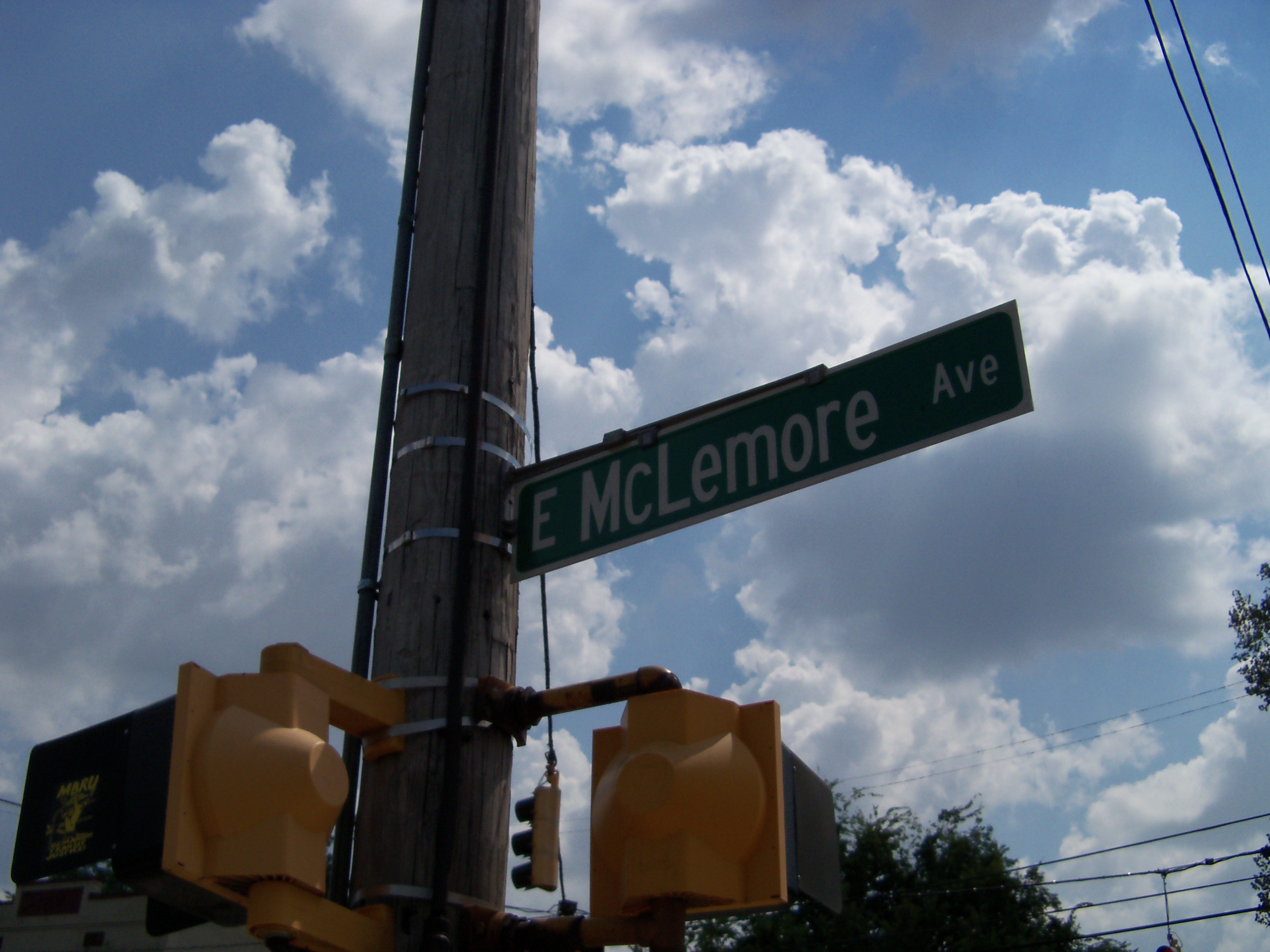
Buck continued. “He keeps talking about our strange car and how blacks and whites need to live together and he says he’s going to Stax for an audition, but it’s been closed for ten years! Remember earlier tonight, when we pulled into town and went down to McLemore? It was an abandoned building and an empty lot!”
“Yeah, well . . .”
“And look at this place, everything is vintage! Vintage shirt, vintage hat, vintage coffee table, vintage table lamp. Look here,” Buck pointed to the nightstand in the bedroom. “He’s even got a vintage Life magazine on the bed stand. It’s weird.”
Don had one ear cocked to the side. “Hey listen to what he’s playing. Isn’t that one of ours?” He was referring to the covers their band played.
I’ll be the moon when the sun goes down,
just to let you know that I’m still around.
The plaintive melody trickled through the door. “He’s got a good voice,” Don observed, calmly. “He should be a performer, not just a writer.”
It was all Buck could do to keep from shouting. He picked up a piece of white cloth from the end of the bed and mopped the sweat from his face. “But, he thinks it’s a new song. And, he’d never even heard of those other Stax hits. Otis is an up and comer? Otis Redding has been dead how long now? This guy is living in his own world. I don’t know how I’m going to get to sleep tonight. I’m going to be wor ried about getting axed or something.”
“Hey, man, you just wiped your face with a diaper,” Don said, pointing to the stack from which they’d come. “It’s okay, they’re clean,” he added, reading the newfound horror in Buck’s face.
Don was still listening to the music coming from the other room. It was some other song now, some spiritual he didn’t recognize. “He’s got good energy, I can feel it. So what if he’s a little wacky, all we got to do is thank him for our hospitality and be on our way in the morning.” He shook his head slowly. “Man, he can sing. I wish one of us could sing like that.”
This only made Buck more agitated. “Can we sleep in shifts?”
Don shrugged his shoulders. “Sure, if it makes you feel better.”
“All I wanted to do was visit Graceland.”
“We’ll get there tomorrow, Buck, no sweat.”
Buck was so nervous and self-conscious, Don sometimes wondered how he ever got into a band in the first place. But, maybe that’s why he got into a band in the first place, he mused. And, he was a bass player, which explained a lot in and of itself. As they walked back into the main living area, Don eyed the telecaster propped up against Roosevelt’s piano. Now, that was a vintage something he’d love to have.
Roosevelt got up early, around eight a.m. The first noises of the day trickled in through the open window, cars and busses, squeaky brakes and honking horns, bits of Saturday waking up. Autumn was finally on the breeze, and Lord, he was thankful for that. He started to set about quietly making breakfast, getting out a frying pan and opening the refrigerator for some eggs. There were still four Dixies in the refrigerator, and he thought about taking them down to Stax, but then he remembered they didn’t drink in the studio either. Over on the couch, one of the boys woke up and lifted his head, and the other soon followed, propping himself up on the floor with his elbows.
“Hey sorry, men,” he said, “this is a small joint, hard not to clatter. Want some eggs and coffee?”
“Sure,” Don, the long-hair, piped up, energized and ready to go.
“Scrambled is all I do. Hope that’s okay.” No answer. “What y’all got planned today? “ Roosevelt asked. “Going to Overton park? Beale Street tonight?”
“We were thinking of going to Graceland.” Curly-headed Buck wiped sleep from his eyes with his palms.
Roosevelt broke an egg on the side of the pan. “Ah, Elvis fans, too. Well, that’s cool, we like Elvis down here. But, all you’ll be able to do is drive by, they always have someone at the gates.”
“We were hoping to take the tour,” Buck continued.
“What are you talking about? You personal friends?” Roosevelt chuckled again, a friendly ha-ha-ha they were growing accustomed to, and stirred up the yoke with his spatula. “I was reading where he’s out in Hollywood right now anyway, doing another one of those jive movies. Lord, what a waste.” He dropped some chopped onions into the pan. Buck shot Don yet another sidelong look while Roosevelt peered into the pan and stirred.
“I like onions,” Don whispered. Buck’s shoulders collapsed, exasperated with his partner’s overabundance of cool.
“If you boys don’t get in the way, you’re welcome to come down to Stax with me.”
Don answered yes for the both of them. Buck kneed him surreptiously.
“It’s business now.” Roosevelt kept stirring the eggs. “But I’ll be glad to have some company. They start early down there, so we don’t have long.”
As it was, the boys barely had time to wolf down their food before leaving the apartment. This bothered Buck immensely; he missed his daily shower and as such felt dingy and scuzzy, his curly black hair matted to his head like a greasy brillo pad. As they pulled out into the street to follow Roosevelt, Buck pulled a little bottle of cheap aftershave from his overnight bag and lifted his shirt and splashed it around his torso to hide what he felt must have been an intense smell. He did this for his own self-image, but in the back of his mind thought, well, there could be girls at the studio. In response, Don, who was driving, raised his right arm and fanned his armpit at Buck, laughing.
Buck held his nose. “Look at his car,” he said, as they turned a corner and saw it in all its glory, “that’s beyond vintage, that’s gotta be from the 50s.”
“Galaxy, isn’t it?” said Dan. “It doesn’t look much older than most of the cars around here.”
“It’s a poor neighborhood.” Buck studied the scenes they were passing. “Some things never change, our man Roosevelt is talking about a change gonna come. Some things change, some things don’t, I guess.” He looked out the window at some black boys and girls playing over an open fire hydrant. They rode in silence for a moment. “Why did you jump at this chance for us to follow him down, anyway,” he asked, “so we could share his embarrassment?”
“I don’t know,” Don said. “It seemed like an opportunity.” Of the two, he was the compulsive one. It always helped in a band to have a songwriting team where one guy was the levelheaded McCartney type, like Buck, and the other was the crazy do anything Lennon man, like Don. “And, we don’t know, maybe there’s some new Stax around there we didn’t see, they’re bringing it back somewhere or something, maybe that’s what he‘s talking about.”
Buck reached over and hit a button on the radio. A fast-talking dj who sounded something like a Southern Wolfman Jack came on and started rapping about a big sale down at Lansky’s on Beale, an upcoming show at the amphitheater, and the latest hit by the Beatles, the fifth number one that year. The familiar opening chord of “A Hard Days Night” rang through the air.
“I have to admit,” Don said, a slight quiver in his voice, “this is starting to weird me out a bit. Have you noticed that we haven’t seen a single car that looked newer than 1964?”
“Yes, I have, it’s like we’re down in Cuba or something.”
“And this guy on the radio, he’s not like an oldies guy; he’s talking present tense . . . and all the lettering, . . .” Don’s old day gig was as a graphic artist. He pointed to a barber shop sign. “. . . it’s all old-time sixties fonts.”
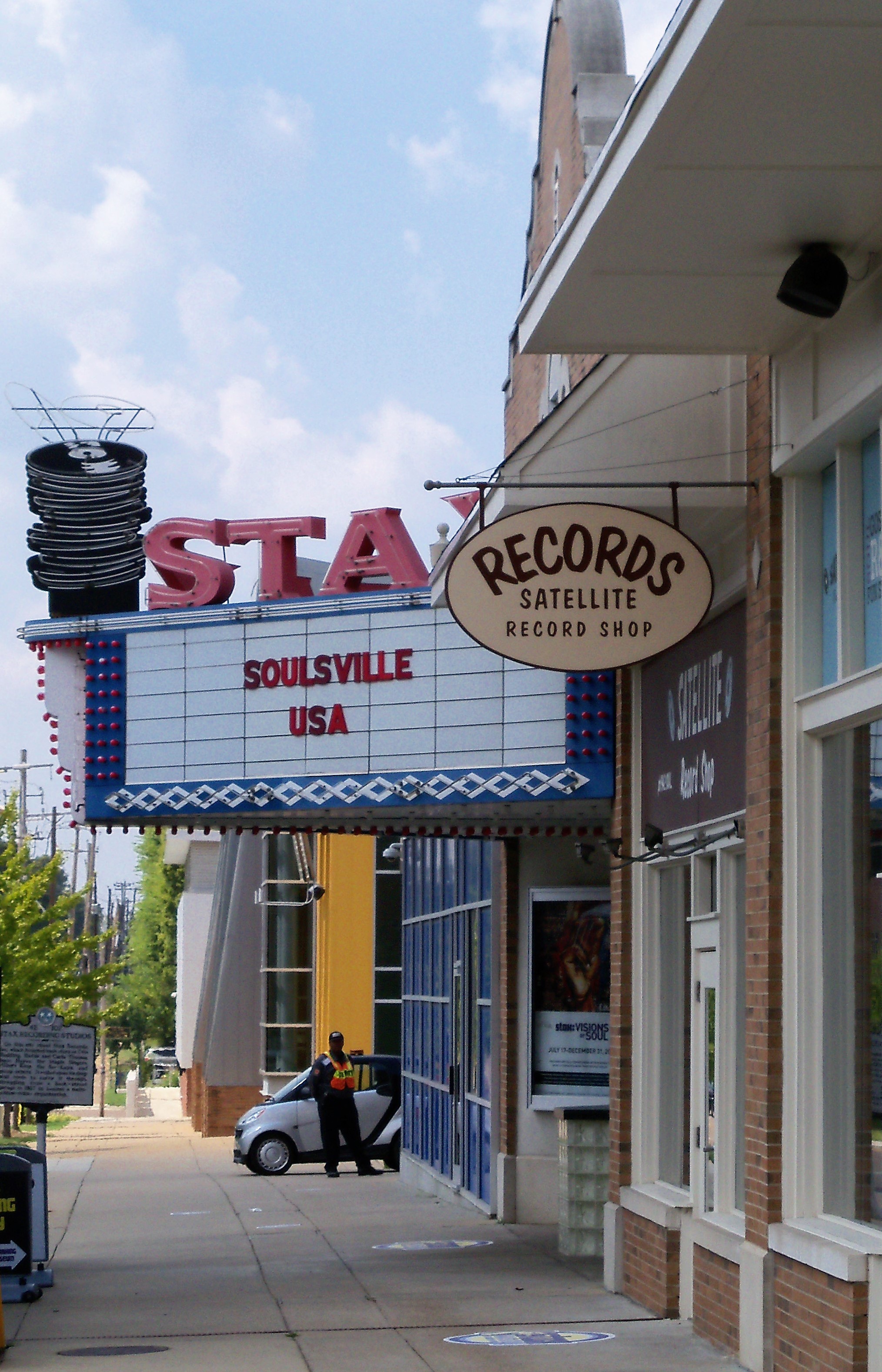
Just then, Roosevelt’s car slowed down in front of a corner grocery store and the boys looked to their left and saw 926 East McLemore Avenue, reborn from the night before, its movie marquee proudly staking claim to SOULSVILLE USA, in all its glory. Next to it was the shop they’d read so much about in their youth, Satellite Records, with bright hand-pressed posters in the window advertising local shows and racks of LPs and 45s visible inside.
A bus stopped at the other side of the street and three black teenage girls got off, skirts billowing in the wind as they hurried into the record store. A sandy-haired white man with a goatee, tan slacks, and black boots walked into the front entrance of the building. Another black fellow, porkpie hat squashed onto his head, hurried out of the gro- cery store and across the street to the studio, carrying a thin square box in one hand and a notebook in the other. Like the cars and Roosevelt’s apartment, everything was vintage, and the air smelled indefinably different to Don, somehow sweeter, effervescent.
“Everyone dresses like our parents here,” Buck said, “only hipper.”
It was like being in a black and white movie, except for the color splashed on everything from the posters on the record store window to the different shades of faces entering the studio to the sun already beating down and bouncing off the chrome bumper of Roosevelt’s car. The neighborhood was coming to life and Stax was the cup of the coffee easing folks into the day. Don and Buck followed Roosevelt across the street and through the front door. Another black girl with a hoop skirt, heavily processed hair, and big bright eyes passed them and said hello to their friend. It seemed as if she worked there, or at least knew Roosevelt. Buck turned and watched her walk outside the building. He could barely see her calves, but her eyes had impressed.
Once inside, they entered Stax’s main studio, a large space with high ceilings and a slanted floor. A drum kit, a couple of Fender amplifiers, a Hammond organ, and a Wurlitzer electric piano were set up around the room. Mi- crophones on heavy stands were scattered everywhere, and large baffles hung from the walls. The guy with the goatee and short cropped hair they’d seen outside sat on a chair at the far or “high” end of the room, aimlessly plunking a bass. Behind him was a glass partition and, on the other side, a recording console and giant wall-sized playback speaker. There was a figure moving beyond the glass, and soon he came around to greet them.
“Hey, Steve.” Roosevelt gestured with his hand. “These are two friends of mine who tagged along, they’re out-of- towners. You don’t mind, do you?”
“No, man, as long as they don’t make trouble,” he replied, deadpan. He had bright blue eyes, a D. A. haircut,and an affable, eager to please demeanor. “Where you boys from?” he asked. Don answered.
“Chicago, ahh, bluesland,” Steve drawled, ever so slightly. “Welcome.” He looked around the room. “We’re just doing auditions right now, so feel free to sit down,” he said, motioning to a row of four metal folding chairs.
They did so, as Roosevelt and Steve headed back be- hind the glass. “Is that Steve Cropper?” Don whispered.
“Steve Cropper’s an old guy with a beard and a pony- tail who doesn’t do anything anymore but play with the Blues Brothers,” Buck said. “That guy is younger than us.”
“But, look, he’s got an old vintage telecaster, and over there,” Don said, excitedly, “that’s a B-3. Maybe that’s Booker T’s.”
Soon more people filed into the room and began milling about, chatting in groups of twos or threes. Many of them seemed to know each other, mostly young men, black and white, their “uniforms” being versions of the clothes they’d seen inside and out, turtle necks, striped short-sleeved shirts, tan slacks, black boots.
The cute girl in the hoop skirt and sleeveless blouse came back in, and Buck kept on eyeing her. Don noticed, and thought, man, can’t he just exude a little cool, for once? He wanted to let him know he’d read once that people can tell when they’re being checked out; it’s like a sixth-sense. Sure enough, the girl turned around and looked in their direction and just then another man came in and blocked the view, shouting, “Carla, what are you doing down here on a Saturday?” “Waiting for you, Al,” she said with a laugh. “Oh, you’re bad.” They hugged and then he laid a couple drum sticks on the kit, and left the room again.

There was a feeling of family in the air. Roosevelt returned to the boys.
“Hey, guys, it’ll be a few minutes. I’ve got to wait my turn, and Otis isn’t here yet anyway. The whole band will be down in a bit.”
“Is that Steve Cropper?” Don asked.
“Sure is, you know him, too?” Roosevelt laughed. “You boys kill me. Listen, I’m going across the street to get a soda, you want anything?” They nodded no. “Okay, behave yourselves.”
Don was itching to go over to Steve and ask him if he could play that telecaster. “Did you see that girl,” Buck whispered. “She’s cute.” Buck was suddenly no longer worried that the cars were old and that everyone dressed funny.
A new arrival came into the studio and shouted, “Hey, whose weird-looking car is that out front? You driving that buggy, Duck?”
“Nope,” the bassist replied. Bass players, thought Don, doesn’t matter where you are, they’re all the same. “It’s ours,” he volunteered.
This fellow was dressed a little slicker than the rest, with a black sport jacket, dark ray-ban shades, and an Afro that seemed to grow out just a little more than everyone else’s. He took off the shades and came over to where they were sitting.
“Wild, man.” He extended his hand, and they shook it in turn.
“My name’s Booker.” He surveyed their t-shirts. “You guys from out of town?”
“We’ve got a band, up in Chicago, and you know, we’re huge fans of yours,” Don rushed along. “We have all of the MGs records and we do some of your stuff, like “Green On- ions” and “Time is Tight” at our sound checks and, well, in our sets, sometimes, too, and . . .”
“Really? I didn’t think too many people north of St. Louis heard what we were cutting here . . . but I appreciate that.” Booker started walking over to his B-3, muttering, “‘Time is Tight,’ is that ours? I don’t remember that, but . .. good title . . . ,” sitting down to trade licks and riffs with the bass player.
Steve came back in the main studio and started get- ting things going; he was obviously the man in charge of the sessions. Once people started auditioning, it went quickly, but most of it was dull. The singers were good, but the songs were just okay and a lot of them were overwrought, studied, or very simple, as if they were indebted more to the music of the 1950s than the 1960s. There were several 1-3-4 songs, too, without much melodic imagination. Al- though Don was lost in the magical vibe around him, the material was not what he’d expect from soul music’s finest city. Occasionally Booker would play from some sheet mu- sic handed to him, while the writer sang his or her song. Sometimes the writer strummed on Cropper’s telecaster, making Don green with envy. Roosevelt and the girl in the hoop skirt came back into the room and sat down in the empty chairs to the left of Don.
Buck reached over, and for the first time since they’d entered the studio, spoke to someone new. “My name is Buck, I’m in from Chicago,” he said, extending across Don and Roosevelt.
“Carla,” was all she said, smiling weakly.
Roosevelt shot a glance to Don as if to say, “Oh Lord.” He looked at his watch.
A song or two later, there was a clamor of activity and laughing from the control room. Duck (Dunn, the bassist) and Al (Jackson, the drummer) rose and gave bear hugs to a black man in a cowboy hat and a suede coat. Apparently, he’d just arrived, accompanied by another fellow, white, sporting a Beatles’ haircut and horn-rimmed glasses. When they entered the studio, they didn’t announce themselves, but nevertheless, all activity ceased.
“Otis!” Steve rushed forward to greet him. “What’s up?”
“You tell me,” Otis replied with a smile, taking off his hat, “you got me out of my hotel bed early to get me down here to hear somebody’s song.”
“This man here says he’s got your next hit.” “Let’s hear it then.”
Don felt the whole atmosphere of the studio change the minute Otis walked in the room, it was an energy, a lifting of spirits, an air of possibility. It was the indefinable “it” that many talk about and is, in reality, very rarely seen or experienced. The other man, presumably a business as- sociate or manager, stood in the corner, silent. Otis leaned on Booker’s organ, waiting, relaxed and welcoming.
Roosevelt sat down at the Wurlitzer, lifted his hands into the air, set them down on the keys gently and began to play. Don said a prayer to himself, giving thanks for the vivid dream or inexplicable reality he knew he was about to experience. Looking to his side, he saw Buck as distracted and dreamy-eyed, no longer nervous, but with other things obviously on his mind. Bass players, thought Don, that’s why they stood in the back.
Roosevelt went out of the verse and into the chorus, and he was working it, hitting that piano harder and pushing his voice to get it over. He had to have balls of iron to play this song cold for Otis Redding, it didn’t matter if, at this point in time, Otis wasn’t huge yet—it was clear he would be.
That’s how strong my love is,
oh That’s how strong my love is.
That’s how strong my love is, baby, baby.
Yeah, mmmm, that’s how strong my love is.
Otis suddenly held up a hand, stopping him. Don feared he might be rejecting the song. But, that would be impossible, wouldn’t it? Or, like players in some old science fic- tion television show, had their appearance here upset the continuity of time and thrown history off its course? “I’ve heard enough,” Otis said, “let’s cut this one as soon as we can. You cool with that Phil?” Phil nodded.
Steve smiled and shrugged. “Fine with me. Let me just talk to the rest of the auditions we had scheduled, ask ‘em to come back next week.” And so he did. And, in no time at all, Don, Buck, Roosevelt, Carla, Phil Walden, Otis’ manager, and Jim Stewart, the founder of Stax and producer of the session who had come down to the studio on Steve’s call, sat in the tiny control room behind the glass, transfixed as Otis Redding sang his version of “That’s How Strong my Love is” all the way through, for the very first time. The MGs—Steve, Al, Booker, and Duck—played impeccably behind him; they were like painters of sound, dynamic and yet tasteful. There was no horn section present, but Steve said something to Jim about adding that later. The depth of emotion in Redding’s voice moved Don immensely. When he reached the choruses, the great singer closed his eyes and held the mike as if performing in front of one, or a thousand, wrenching meaning from every syllable of the lyric.
As Otis sang, Don hung on the lyrics and thought about every boyhood crush he’d ever had, all the girlfriends he’d dated, and who his wife of the future might be. Otis rode the peaks and valleys of the tune with his voice and Don remembered the reasons he started playing guitar and writing songs in the first place, and how he’d hope to one day pay a small part of that debt back, the joy and promise music had given him. Then, Dan thought about how in a world so wrought with conflict and sorrow, there could still be so many things of healing and great beauty. And tears began to run from his eyes; he faked a quiet sneeze, wiped them dry, and soon, much too soon, the take came to an end. For some reason unbeknownst to him, Otis suggested they do it again. And, again. And, after that third time, all parties agreed they had a keeper. On each take, however, Don vainly fought away tears.
Everyone was silent during playback. Afterwards, Otis and his manager shook hands all around and left quickly, taking the wind out of the room.
“I think we got a hit,” Steve said to Roosevelt.
Don was nearby. “Oh, do you ever. The Stones will have a hit with it, too.” He blurted out excitedly.
“The Stones?” Roosevelt laughed. “Whatever you say, man.” He continued, “Hey we’re all going out for some barbeque, you want to join us?”
Don declined the invite on their behalf and thanked his host for his hospitality. While he was normally game for anything, he felt that in some intuitive fashion, they’d pushed their luck as far as it would take them.
“No sweat, you were my good luck charms.” Roosevelt took out a piece of paper and scribbled. “Here’s my number, look me up next time you’re in town.”
Don took it and told him they would. As they headed out of the dark studio and back into the sun, Buck whispered, “Why are we leaving now?”
“I thought you were freaked out.” Don lied just a little. “And I didn’t want to overstay our welcome, you know . . .”
Out on the sidewalk, Buck popped his head into the record shop. Carla was there, working the counter. “Bye,” he said.
Bass players, thought Don, they never learn.
As they approached their car, Don tossed Buck the keys. “Your turn.” He pulled the map out of the glove compartment. “What do you think? Graceland?” Don felt strangely at ease considering the turn of events he’d just experienced. There was something infinitely clear about having reality stripped down to its basics, in this case the simple fact that he was in Memphis with his bandmate at some indefinite moment in time different from the one he was used to. It was a short drive to Elvis’ house and the boys were quiet along the way. It didn’t take long for them to realize nothing had changed. The street sign read South Bellevue Road, not Elvis Presley Boulevard, as it would later be renamed. And Graceland was where it would always be, but without the gift shops, tour uses, and post-mortem exploitation. It was just a big mansion with a guardhouse and famous double gate at the entrance to the drive, all decked out with musical notes. A few flowers and gifts to the King were laid on the sidewalk. Whether Elvis was at home or in Hollywood, it was clear that he was most definitely alive.
Buck spoke first, “I don’t know man, this is still too weird for me. I say we head home. We could take turns driving and get there by early morning.”
“You don’t want to stay here?” asked Don
“What do you mean?”
Don had been thinking about other things as well. “Well it’d be kind of cool to be stuck here in 1964, you know, we could get our foot in the door at Stax, maybe get some songs cut . . . maybe do some sessions.”
“Are you crazy?”
“We could invest in all the right inventions, you know anticipate the stock market and stuff,” Don continued. “It seems like a sweet deal to me. And we’ve already got our in.”
“And what about our families, and our friends, and the future of the band?”
“And what about Carla?” Don said, pushing the button.
There was a long pause after this. They were approaching the lights of downtown Memphis. Buck pulled over at the side of the road and put on his hazards. “How about this?” he said, “how about we start driving back to Chicago, if we get there and it’s still 1964, we come back here and work our connections. If we get back to 1984, from where we came, then that’s how it was meant to be.”
Don couldn’t argue with the logic, so he agreed to the deal, although secretly, he was banking on a permanent time warp. On the way home, they took turns, one sleeping while the other drove, and then reversing the trend. When Don was behind the wheel, he put in Otis Redding’s Greatest Hits, played both sides, back and forth and then repeated the song they’d seen cut, at least three times.
I’ll be the weeping willow drowning in my tears
You can go swimming when you’re here
I’ll be the rainbow when the sun is gone
Wrap you in my colors and keep you warm
After awhile, Don put his hand to the window and felt the cold. Winter comes early in Chicago and he pulled off for gas as they reached the outlying suburbs. Gas prices were high. The Tribune had a headline about something President Reagan was doing. He switched on the radio and it was all Prince and Springsteen. They were back.

Don and Buck never told the rest of the band what had really happened in Memphis; they figured they’d never believe it. But the memory stayed with them and sometimes on tours, if the other guys were sleeping, they’d talk about it a little bit, in hushed tones, and in cautious code, like “remember Otis?” They played Memphis several times over the next couple of years, and they’d always take time to go around and sightsee. Elvis’s empire grew and shrank and grew, and the Piggly Wiggly disappeared. The Peabody Ducks kept walking through the lobby and the heat beat down on the city streets, as it always does. They’d drive by McLemore Avenue to pay homage to the great soul music that came from that site. The whole band would get out and stare at that empty lot and say nothing, while Buck and Don’s thoughts circled around and around.
The band toured the country quite a bit, made one record and then split up. Buck started a little record shop that sold vinyl and reefer paraphernalia. He’d loosened up enough to recognize where his real profit margins lie. But, he lived in a small conservative town and the cops busted him and he was stubborn about it and even did a little jail time. He got out in a few months and though they’d grown apart, Don would come in from time to time and play backgammon while they listened to Otis records. It was their little way of staying connected, he supposed. But, it wasn’t enough, because a few months after Buck got out of jail, he hung himself.
Don kept playing music, though he decided it would be easier to do as a solo artist, either slinging his guitar by himself or hiring musicians to back him as a tour or session would necessitate. And, he kept visiting Memphis, and he kept visiting McLemore. It had special significance for him now, because he was visiting not just for the music, and the memory of Otis, but also the memory of Buck.
Twenty years after the time that they’d gone back in time twenty years, Don showed up at McLemore one day to find that Stax/Volt was back. Someone with vision built a museum and music school on the former site, perfectly recreating the marquee and the old record shop, right down to the lettering on the side of the brick wall facing College Avenue. He pulled up behind the center, parked his car, and bought a ticket to take the tour. As he was doing so, an eager lady behind the counter pointed to a little theater on the left and said “you want to see the film, it’ll give you all the inside story.” Don thought of many things to say, but simply thanked her, entered the theater and sat in the dark by himself, waiting for the film.
It began with a soundtrack of great soul music, interspersed with commentary from all those involved in the label and studio’s beginnings—Steve Cropper, David Porter, Booker T—faces etched in Don’s memory, from books, and of course, his experience of many years ago. Then there was live footage, the MGs, the Mar-Kays, and Carla Thomas singing “B-AB-Y.” Don thought of his old friend Buck. And, finally, there was some grainy black and white footage of the late Otis Redding singing a song in London before a live audience, the same song that Don heard recorded so many years before.
I’ll be the ocean so deep and wide
I’ll get out the tears whenever you cry
I’ll be the breeze after the storm is gone
To dry your eyes and love you warm.
That’s how strong my love is.
Don looked around the theater; it was filled with young African-American high school kids, boys and girls on a field trip, eyes riveted to the screen as Otis sang. There was also an older couple holding hands, tourists from Germany, he’d overheard them chatting. Don wanted to stand up and testify and say, that’s really how it was, this was an amazing time with amazing people making amazing music. But, he knew that would be foolish, and so, instead, he remained where he sat, in the back row, this time letting his tears fall unhindered. And, as they soaked into the carpet, Don paid silent homage to all the beauty there is in the world and all the good days that can make up a life.
from Bothering the Coffee Drinkers

Finalist, Independent Publisher Awards
https://www.amazon.com/Bothering-Coffee-Drinkers-Doug-Hoekstra/dp/0972860444
 Doug Hoekstra