The Equal Justice Initiative was founded in 1989 by Bryan Stevenson, a public interest lawyer and author of “Just Mercy.” EJI is a nonprofit that provides legal representation to folks illegally convicted, unfairly sentenced and/or abused in prison. EJI is anti-death penalty and helps with re-rentry assistance. EJI also runs the Legacy Museum and the National Memorial for Peace and Justice, both of which I just toured, down in Montgomery Alabama.

The Legacy Museum is built on the former site of a cotton warehouse, appropriately. The exhibits begin with stories of the 5,000,000 slaves brought to America, follows it through trauma (“the weeping time”) into reconstruction, Jim Crow, lynchings, right up to mass incarceration and the death penalty. The museum presents an effective combination of sculptures and graphics and powerful stories, videos, and statistics, which maybe one knew, but maybe one didn’t. Like did I really understand that 75% of the population of Montgomery (and Charleston) in the 1800s were slaves? Or that interracial marriage was only made legal in Alabama in the year 2000? Or that one in 8 of individuals executed, one is exonerated? Or that 13 states have NO minimum age to try a child as an adult?

Powerful was the row upon rows jars of soil lined up across one wall; ancestors of lynching victims have been this earth from sites where their loved ones were lynched. The National Memorial for Peace and Justice (pictures here), echoes that theme, a reminder of the 4,000 plus victims murdered between 1877 and the 1950s, each column representing a name, a place, a person an event. One walks inside the sculpture, and the memorials rise above you. EJI as an organization ,and as a museum and a memorial, works to draw the parallels between slavery, lynching, and the death penalty, very effectively and in a way that makes it more present and active comparative to places I’ve visited in Birmingham and Memphis.
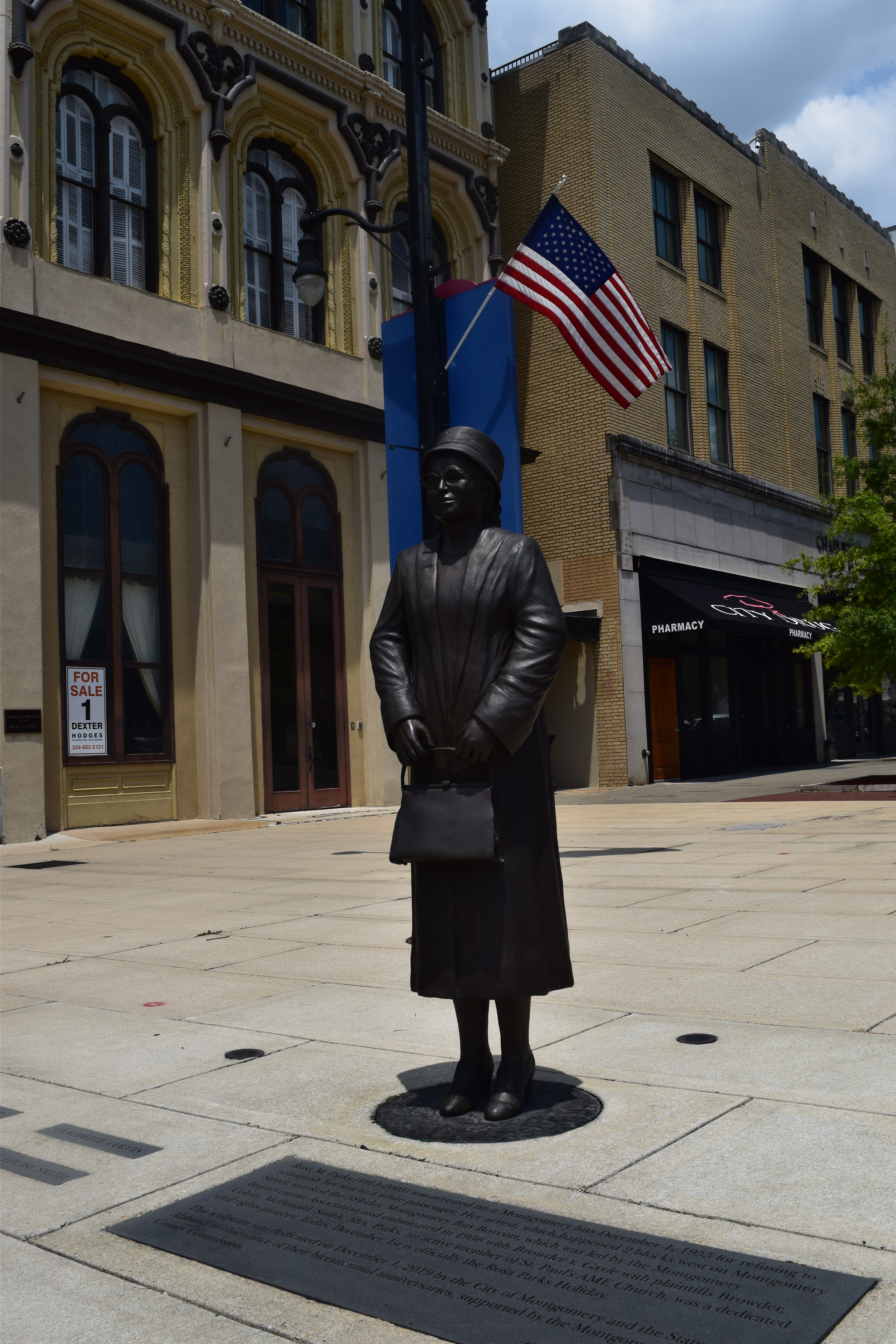
Also took some time to tour the Rosa Parks Museum and visit the site where she took the bus that day; all points stressed how it was a movement of foot soldiers, the many who boycotted, were arrested, and took risks, not for themselves, but for those who would come after. Afterwards, I drove down Rosa Parks Avenue and crossed over Fred Gray Avenue, named for the lawyer who represented her, reminded that until late 2021, it was still Jefferson Davis Avenue. I don’t think it’s too woke to say that was a good idea and a long time coming.
 Doug Hoekstra